|
What does a Stabilizer do? - Kato's competitors don't always mention the need for lateral stabilization, but we believe it is an essential consideration for any quality installation. Apart from the direct downward load that a dinghy imparts on davits, there is considerable sideways load. This load is imparted by the heeling angle of the mother vessel, and the wave action under the vessel.
This can be particularly important if the boat is rolling while you are lifting the dinghy from the water as there is nothing to stop dinghy from pulling the davits from side to side until it is fully hoisted and secured.
Side loads must be reduced by using Kato's Secure-It's or spring lines on the dinghy to stop the dinghy from moving. There is always some residual movement and well stabilized davits make a difference.
How do I achieve this stable arrangement? - Historically, rail mounted davits were secured by locating pins near the base (Kato's older Bay Model) or by restraining wires between the davits, and from the corner of the stern rail (Kato's Island Model).
Notice that on our Island model davits, where we expect that heavier outboard motors, rigid bottom inflatables (RIB’s), and larger dinghies will be used; Kato recommends that stabilization should be implemented near the outboard end of the davits, and not close to the stern rail, where the length of the davit can become an overwhelming lever arm.
We offer three styles of rigid stabilizers for the Island model davits; one is fixed in place, and two are removable. The ‘Slip-On’ stabilizer is not available for the BayII model davits
Fixed Stabilizers:
Method #1 - The stainless steel SS100 fixed stabilizer
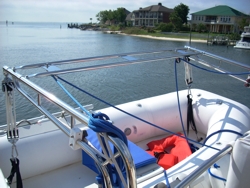 |
Made from two stainless steel tubes with three 3” cross plates connecting them,
the cross plates and tubes form a grid which is where the stabilizer gets the rigidity. This stabilizer clamps to the davits and can be removed by simply undoing four bolts. The cross plates provide a surface for attaching antennas, etc. Each plate is already pre-drilled for mounting our light brackets, flag sockets, or solar panel brackets - see (saildavits-optional.htm)
Click photo to
enlarge |
What's involved in installing the 'Fixed' Stabilizer? Each stabilizer is provided with everything needed to install them. The SS100 model is made to the exact length required, and simply bolts in place. They come with complete step-by-step instructions and are easy to install. The fixed stabilizers can be removed for winter storage, etc. by undoing four bolts.
Removable Stabilizers:
Some of our customers want to utilize the folding capabilities of our davits. They want a unit they can just slip in place when using their davits and easily remove otherwise.
Method #2 - Stainless steel 'Slip-on' stabilizer
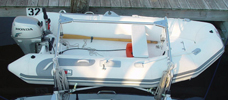 |
Available only for the Island model davits, this highly polished stainless steel unit slips over the outboard end of each Island davit with the welded 'nub' serving as a locator. A polished stainless steel pin locks it in place. Because both davits are gripped over 5½” of their length; the stabilizer forms a rigid triangulation, thus preventing any lateral movement of the davits.
Click photo to
enlarge |
Method #3 - The Cross Tube stabilizer
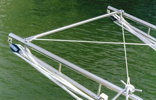 |
Available for either the Island or the BayII model davits, this stabilizer uses a tube to hold the davits apart and crossed lines or wires to stop the davits from swinging left and right. Made from either 1” (25mm) or 1-1/4” (32mm) diameter stainless steel tubing, this is an inexpensive method of having a removable stabilizer. The choice of tube diameter depends on the length. The larger tube is used when the length is over 65” (1650mm). It does exactly the same job as the other stabilizers.
Click photo to
enlarge |
The cross tube stabilizer is simple to make and that keeps the price down. Of course, in the usual Kato style we weld the ends and then blend the welds into the metal so that you can’t see them. It is a requirement that they use diagonal wires or ropes to make the whole system work, and these wires/ropes can be a hindrance when standing on a transom scoop. On boats without a scoop (or similar) they present no problem.
|